The Folded Mind Go to the atlas →
Back
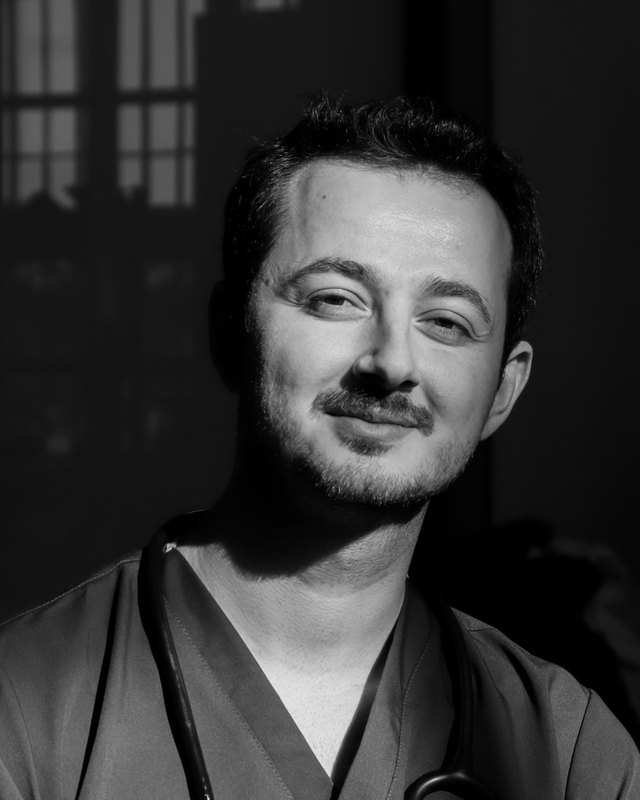
Alperen Mert Çetin, MD, in scrubs with a stethoscope

Created by

Alperen Mert Çetin, MD

Resident in child and adolescent psychiatry

Like you reading these lines, I have long been drawn to psychiatry, psychology and neuroscience, and eager to learn. What drew me to these fields was the richness of abstract thought and theory, the countless questions waiting to be researched and, above all, the unknown of what goes on behind a person’s eyes. That unknown awakens curiosity and a desire to explore; in Panksepp’s language, a state of SEEKING.

In residency, the “why” and “how” questions that theory-based approaches raise but leave unanswered turned me toward the place where thought is produced: the organic side. Affective neuroscience, polyvagal theory, the Bayesian brain, mentalization… The more I read, the more the brain’s processes and regions turned into a heap of words that was hard to picture. That is when I realised how much a psychoanatomy atlas like this was needed.

My aim is not only to offer an atlas you can work with, but to keep a finger on the pulse of neuropsychiatry around the world, to follow the growing neuroscience community and to find a way to take part in its work.

The atlas is free. I would be glad to hear your suggestions, error reports and ideas for collaboration.

Hoping our paths cross in academia.

Contact · email and Instagram [email protected] @thefolded.mind
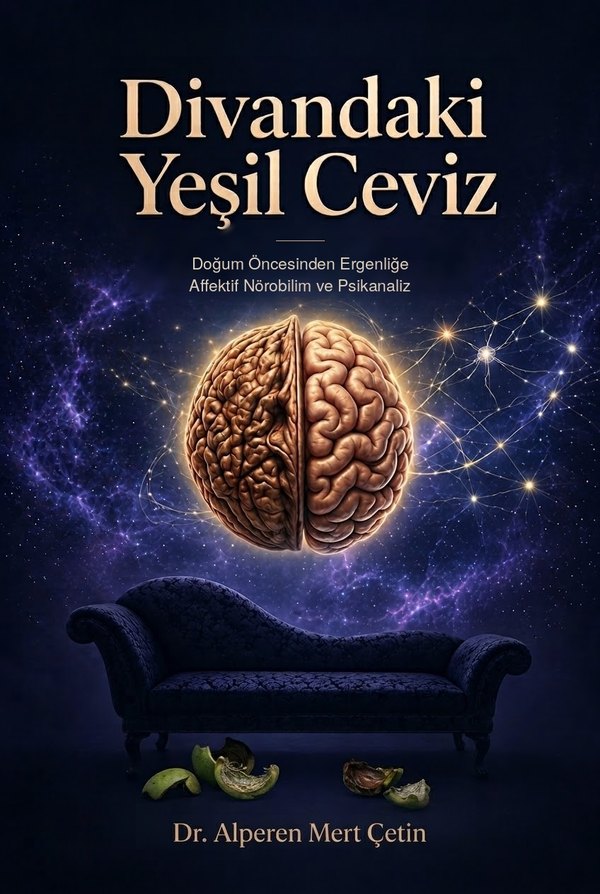
Cover of the book The Green Walnut on the Couch (Divandaki Yeşil Ceviz): a sphere that is half walnut, half brain, above a couch

The book

A resident’s notebook

The Green Walnut on the CouchAffective Neuroscience and Psychoanalysis from Before Birth to AdolescenceTurkish original: Divandaki Yeşil CevizStill in progress; it will be made available here when complete.

When I first bought Panksepp’s 700-page book on affective neuroscience, I was full of excitement. As I read on, the translation and the technical detail became stifling. That is when I decided to draw up a curriculum for myself: seven or eight months of study through both theory and everyday life, in back-and-forth conversation with large language models, with plenty of free association. I gathered the notes I took after each lesson; enriched with metaphors and creative definitions, they grew into a 260-page resource I have enjoyed working with.

In these notes I tried to bring together the dynamic perspective of psychoanalysis and the mechanistic approach of neuroscience; starting, as far as I could, from the ideas of every major theorist, they are written around many topics and diagnoses. Rather than an academic book, think of it as a psychiatry resident’s notebook. I am still working on it, and when it is finished I will make it available here.

The atlas’s “In the book” layer comes from the notes’ Neuroanatomical Correlation chapter: select a region to see where it appears in the notes and which emotional system it relates to.

Happy reading.

Contents · 22 chapterssample pages in chapter 20
  1. Phase 0 — Before Birth: Fetal Programming
  2. Phase 1 — Foundation (0–6 months): Damasio, Freud; OCD and autism
  3. Phase 2 — Deepening (6–12 months): Winnicott, CARE and PANIC/GRIEF, Klein
  4. Mahler: Separation-Individuation
  5. Phase 3 — Integration (1–2 years): Schore, polyvagal theory, Fonagy, Bowlby
  6. Phase 4 — Synthesis: Friston and Solms
  7. Phase 5 — Advanced Integration: from Stern to Bion
  8. SEEKING and PLAY
  9. RAGE
  10. The FEAR System
  11. The LUST System
  12. Oral, Anal and Phallic Stages
  13. The Latency Period
  14. Genital Stage I: Mature Love
  15. Genital Stage II: Identity and Body Schema
  16. Erikson: Eight Stages
  17. Anna Freud: Defenses
  18. Trauma and PTSD in Children
  19. Case Formulation Template
  20. Diagnosis-Based Analyses
  21. Research Proposals

The book is written in Turkish; in the English version of the site and the atlas, its passages are shown in translation.